
Your AI Roundup

Welcome to this week’s AI round-up! In this edition, we cover the release of Claude Fable 5 and the access constraints that followed, the rapid rise of AI agents as contributors to critical open source software, Neura Robotics’ $1.4 billion Series C, and three start-ups raising funding for projects in clinical documentation, enterprise knowledge infrastructure, and industrial condition monitoring.
This week at a glance:
Claude Fable 5 and the Mythos it hides: Anthropic's first public release of a Mythos-class model leads most major leaderboards, but ships with a routing layer that redirects high-risk queries, costs twice the Opus series, and moves to usage-credit billing on 22 June, making capacity once again the binding constraint.
AI agents are writing open source code: agentic contributions to critical open source repositories grew from 2% to 10% of pull requests between October 2025 and May 2026, with human-authored contributions declining for two consecutive months since March, concentrating pressure on a small number of volunteer maintainers.
Neura Robotics raises $1.4 billion: the largest funding round to date for an EU full-stack robotics company places a European firm at the top of a global ranking otherwise led by US players, though the open question remains deployment rather than financing.
The real cost of AI: a review of the economics behind the 280-fold reduction in inference costs since 2022 finds that the gains rest on the US-China rivalry remaining neck and neck, with the inverted-U of innovation pointing downward if one side pulls decisively ahead.
1. Claude Fable 5 and the Mythos it hides
Anthropic has released Claude Fable 5, the first public version of a Mythos-class model, built on the same underlying architecture as the system kept behind Project Glasswing since April.
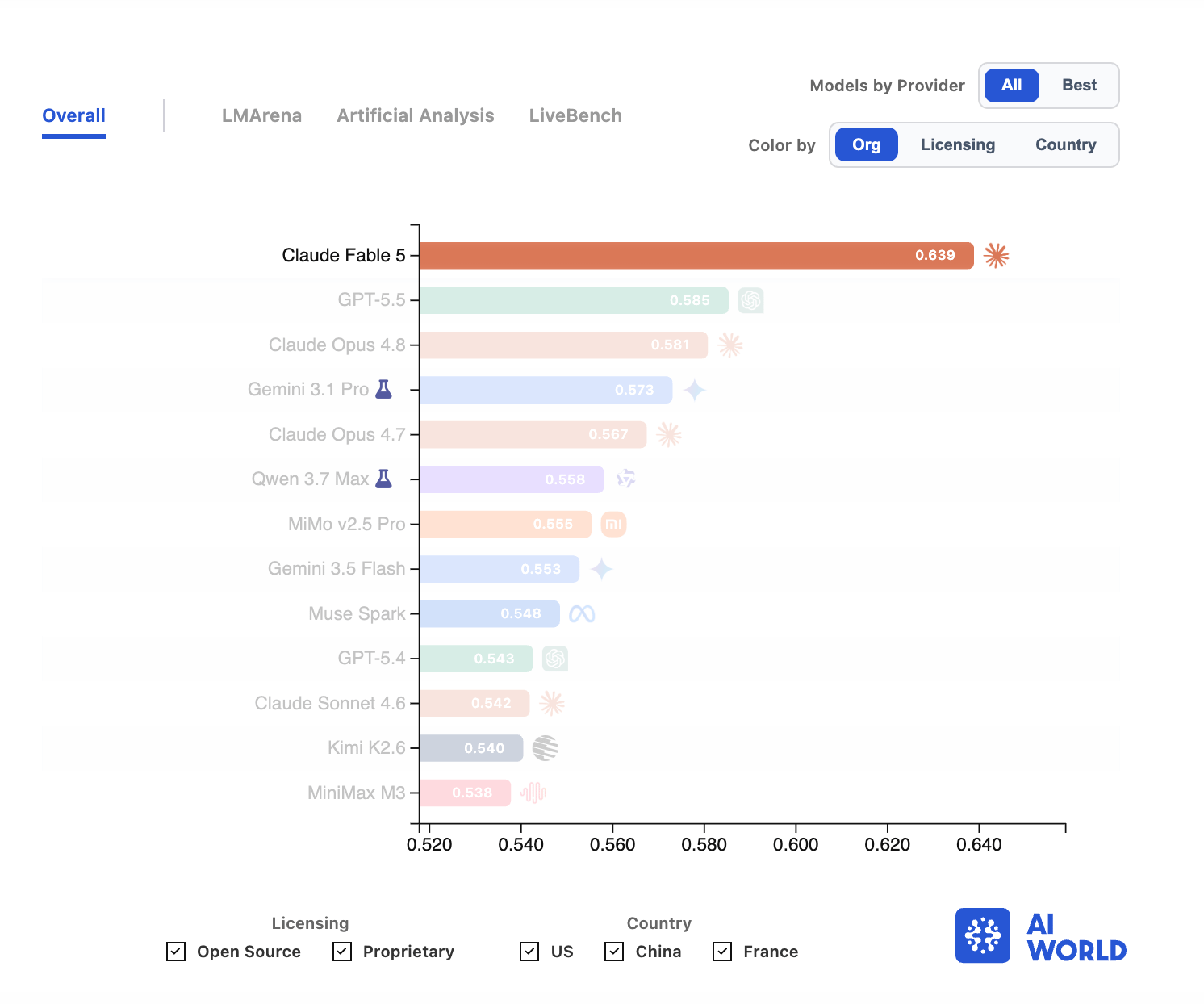
Fable 5 is effectively Mythos with a routing layer that transparently redirects queries touching cybersecurity, biology, chemistry, and related high-risk areas to Opus 4.8, triggering in under 5% of sessions on average and deliberately tuned to over-block while false positives are reduced. On most major leaderboards the model leads by a clear margin, with early deployments at Stripe, IMC, and Cursor each reporting substantial gains on complex, long-context tasks.
→ Read the full story at AI World
2. AI agents are increasingly writing open source software code
Agentic contributions to critical open source repositories, those identified by the Open Source Security Foundation as the backbone of projects including Node.js, npm, and Raspberry Pi, grew from 2% to 10% of all pull requests between October 2025 and May 2026, a sixfold increase in six months.
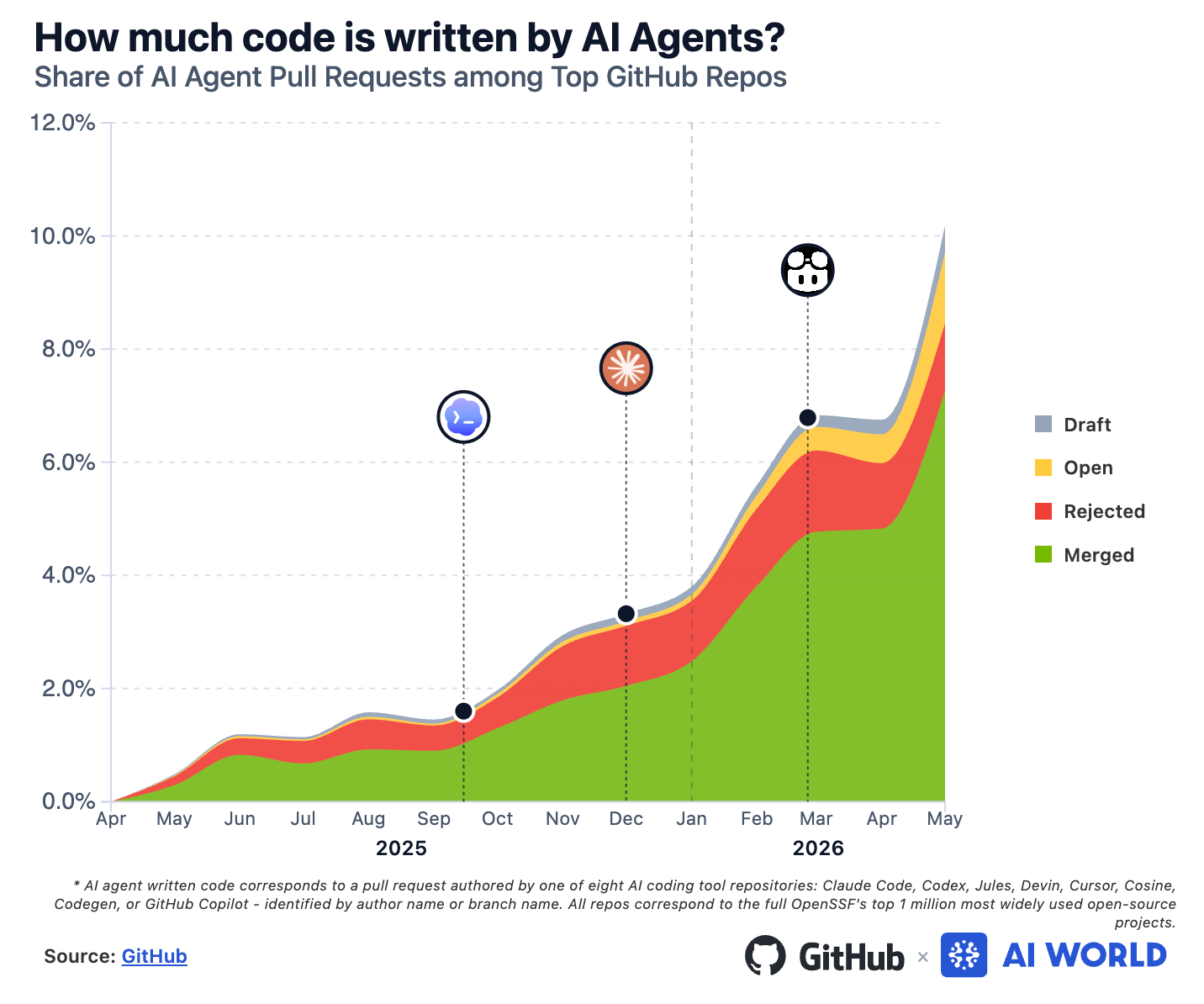
The rejection rate for AI-authored contributions has fallen alongside the growth, suggesting the additional volume is not uniformly lower quality, but the pressure is concentrating: human-authored pull requests have declined for two consecutive months since March 2026, and many of the most critical codebases are maintained by one or two individuals.
→ Read the full analysis on AI World
3. Neura Robotics: is the EU finally in the race?
Neura Robotics, based in Metzingen, Germany, has closed a $1.4 billion Series C led by Tether, with Qualcomm, Amazon, Nvidia, Bosch, Schaeffler, and the European Investment Bank among the backers, in what the company describes as the largest funding round to date for an EU full-stack robotics company.
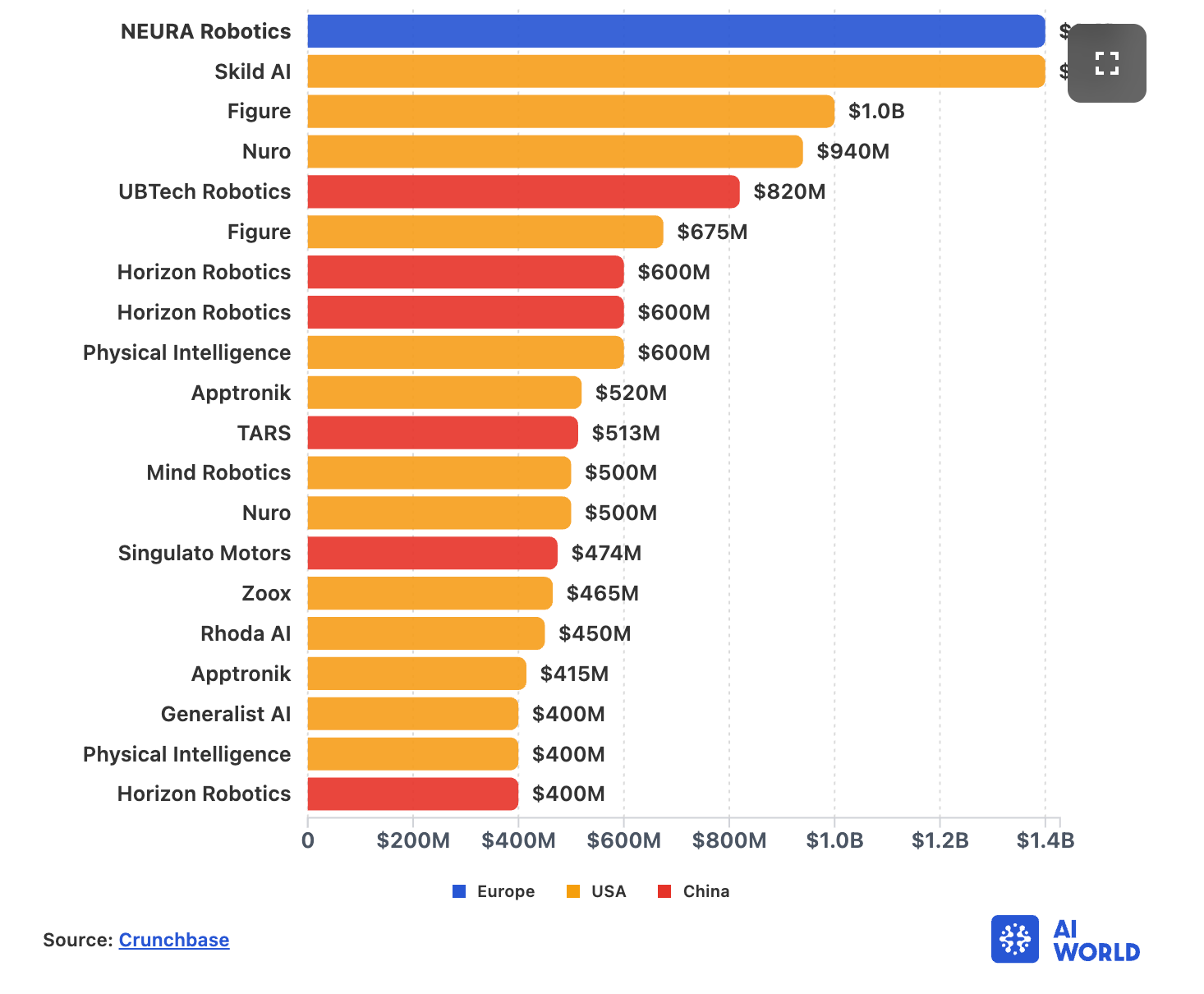
The round is roughly 5.8 times the next largest European robotics round on record and places Neura alongside Skild AI at the top of the global Series C and below rankings, ahead of Figure's $1.0 billion. The capital is directed at serial production and Neura's training infrastructure, with the 4NE-1 humanoid still being prepared for volume production rather than shipping at scale today.
→ Read the full analysis on AI World
4. This week's most notable AI research papers
This week's selection examines the economics behind the 280-fold reduction in frontier AI inference costs since 2022, tracing the role of US-China competitive dynamics, export-control-driven algorithmic innovation, and the inverted-U of innovation that suggests the gains depend on the rivalry remaining evenly matched.
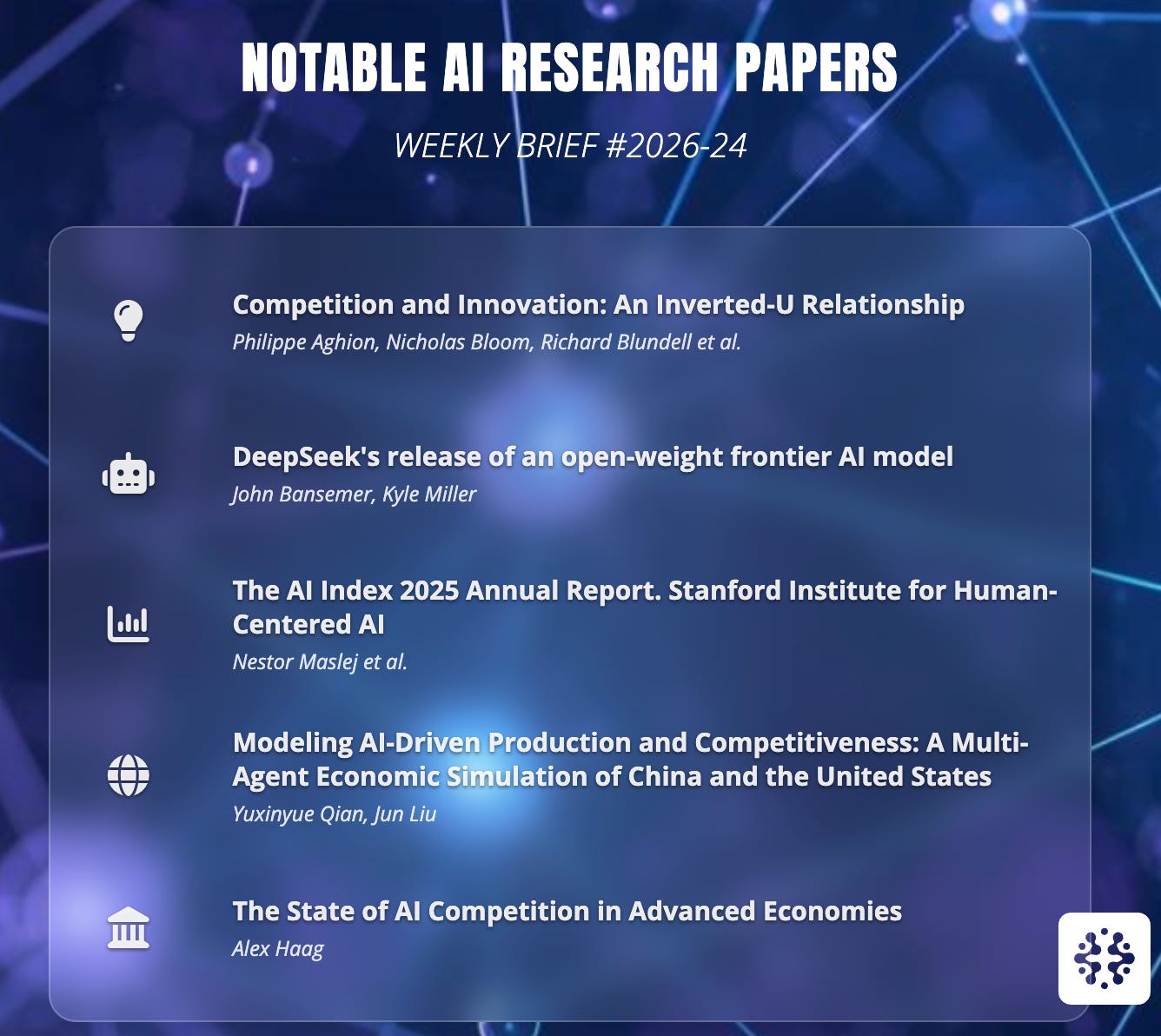
→ Read the full paper summaries on AI World
5. Two policy briefs on education and open source
A World Economic Forum Insight Report places the risk of AI in education not in teacher replacement but in the removal of productive struggle: one study it cites found students who used an AI tool scored worse than peers who never had it once it was withdrawn, and the report organises the conditions for durable learning gains into four interdependent levels covering data governance, institutional capacity, pedagogical practice, and inclusive access.


An OECD paper for the G7 presidency finds that open-weight models are now only months behind closed ones and represent four fifths of downloads on Hugging Face despite being two thirds of licensed models, with a 10% rise in global open-source AI work tracking a 0.5% rise in long-run GDP across the 33 countries studied, while noting that openness at the model layer does little for real autonomy when compute and chips remain concentrated.
→ Read the full analysis on AI World Linkedin page
6. Startup spotlights of the week
This week's selection showcases the application of AI to structural gaps in clinical documentation, enterprise knowledge accumulation, and industrial condition monitoring.
🇳🇱 OurMind: Netherlands-based, co-founded by Paul Koning, Fredrik Gustafsson, and Marco Ferraz. OurMind records clinical consultations as ambient audio, generates structured medical notes pushed directly to patient records via EHR integration, and handles surrounding administrative tasks including referral letters, sick notes, and inbox triage, currently live at over 300 general practices and 14 hospitals across the Netherlands. Raised €2.1 million in a round led by 4impact Capital.
🇬🇧 Zaro: London-based, co-founded by Michael Bajwa and Qian Zheng. Zaro provides a shared context layer that sits below individual AI tools, storing company data, decisions, workflows, and operational history in one persistent workspace so that agents and applications can access the same accumulated knowledge rather than starting from an empty context. Raised $5.1 million in a pre-seed round led by Cherry Ventures.
🇫🇮 Rotomate: Finland-based, founded 2024 by Mikko Kuusisto and Dr Jesse Miettinen. Rotomate ingests vibration measurements alongside maintenance records and operational history to produce explained alerts, root-cause analysis, and prioritised work-order suggestions, with outputs tailored by role across vibration analysts, plant managers, and maintenance planners. Raised €2.1 million in a pre-seed round led by Kvanted.
What’s next
For more updates, research and insights across the AI ecosystem, visit aiworld.eu. Subscribe to receive next week’s round-up directly in your inbox and stay ahead of key developments.
Have a great weekend!
Gaia Cavaglioni
On behalf of the AI World Team.