
Your AI Roundup

Welcome to this week's AI round-up! In this edition, we cover the widening AI adoption gap between large and small European businesses, new research on when AI actually generates productivity, three policy briefs on model memory, agent regulation, and hardware disclosure, and three startups closing rounds across compliance automation, regulated finance, and industrial process control.
This week at a glance:
The real obstacle to AI in European businesses is not the technology: Eurostat data across 157,000 firms finds that 70% of companies that considered AI but did not proceed cite a lack of relevant skills, a barrier distributed almost evenly across company sizes, pointing to an organisational integration problem rather than an access one.
The cheap way to use AI is the expensive one: three converging studies find that productivity gains from AI concentrate around complementarity, while substitution produces thinner returns and invisible downstream penalties estimated at millions per year for large organisations.
Three papers on memory, agents, and hardware: a Carnegie Mellon paper embeds sleep-like consolidation into language models, a systematic EU compliance mapping finds that high-risk agents with untraceable behavioural drift cannot currently be placed on the EU market, and a Hugging Face and CEPS audit finds that more than 40% of the top downloaded models disclose no recoverable signal of the chips that trained them.
Startup spotlights: Bayshore, Gradient Labs, and Gigaton each closed rounds this week across legal and compliance automation, regulated financial operations, and AI-driven industrial process control.
1. The real obstacle to AI in European businesses is not the technology
Eurostat's 2025 survey of 157,000 European businesses finds that 20% used at least one AI technology, up from 8% in 2023, but the adoption gap between large firms (55%) and small ones (17%) has widened from 24 to 38 percentage points in two years. Among companies that considered AI but did not proceed, 70.3% cite a lack of relevant skills as the primary barrier, a figure that varies only marginally by company size: 70.9% among small firms, 65.1% among large ones.

The McKinsey Global Institute's parallel finding for the US market, that fewer than 40% of organisations investing in AI report tangible impact on results, and that the gap is explained by organisational rather than technological factors, suggests a consistent mechanism: the bottleneck is not access to tools but the capacity to integrate them into workflows in a way that produces measurable output. If that mechanism holds in the European context, the widening adoption gap between large and small firms likely reflects a deeper and compounding gap in organisational readiness.
→ Read the full analysis at AI World
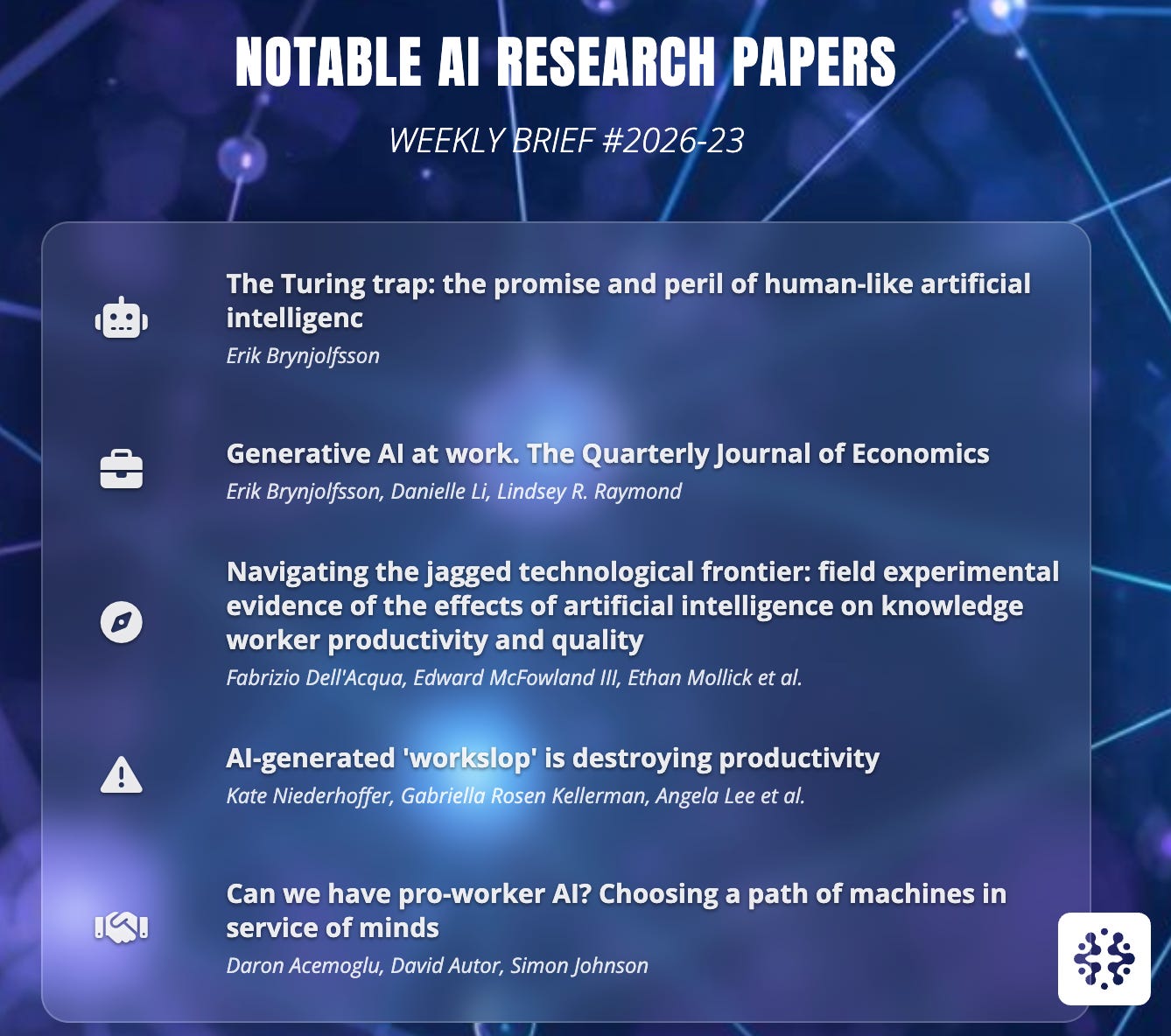
2. The cheap way to use AI is the expensive one
This week's selection examines the conditions under which AI actually generates productivity, from the complementarity findings of randomised trials to the hidden costs of miscalibrated output and the structural incentives that currently favour automation over augmentation.
→ Read the full papers summary on AI World
3. Three papers on memory, agents, and hardware
A Carnegie Mellon and University of Maryland paper embeds a sleep-like consolidation mechanism into language models, where once active memory fills the model compresses recent context into its weights rather than discarding it, with gains appearing specifically on tasks requiring multi-step reasoning rather than simple recall. A systematic compliance mapping from Piccadilly Labs and the Association of AI Ethicists finds that the EU AI Act regulates what an agent does rather than how it is built, with obligations triggered by external actions across GDPR, the Cyber Resilience Act, the DSA, and sector-specific rules; the paper's sharpest conclusion is that a high-risk agent whose behaviour drifts over time in untraceable ways cannot currently be placed on the EU market at all.


A Hugging Face and CEPS audit of the top 4,000 most downloaded models finds that more than 40% disclose no recoverable public signal of the hardware that trained them, that NVIDIA dominates but Chinese developers increasingly mix in domestic accelerators, and that serving infrastructure matters more than is disclosed: one model scored anywhere from roughly 0% to 85% on the same benchmark depending solely on which provider served it.
→ Read the full analysis on AI World Linkedin page
4. Startup spotlights of the week
This week's selection showcases the application of AI to structural gaps in legal and compliance operations, regulated financial workflows, and energy-intensive industrial process control.
🇩🇪 Bayshore: Munich-based, co-founded by Paul F. Welter, Philipp Wiegand, and Erik Krauter. Bayshore encodes regulations and internal policies as deterministic, machine-readable logic built by specialist lawyers, enabling AI agents to resolve routine compliance cases automatically and route complex ones to human reviewers with full audit trails, EU-hosted and ISO 27001 certified. Raised $8 million in a seed round led by Earlybird Venture Capital.
🇬🇧 Gradient Labs: London-based, founded 2023 by Dimitri Masin, Neal Lathia, and Danai Antoniou. Gradient Labs has built an agent platform for regulated financial operations, handling card replacements, account freezes, fraud triage, complaint resolution, and lending workflows within audited constraints, targeting the complex tier of customer operations that most AI agents do not reach. Raised $26 million in a Series A extension led by Octopus Ventures and CommerzVentures, bringing total funding to approximately $42.8 million, June 2026.
🇬🇧 Gigaton: London-based, founded 2020 as Carbon Re, a joint spinout from UCL and the University of Cambridge. Gigaton's self-learning control platform replaces rather than overlays existing industrial control infrastructure, autonomously adjusting fuel mix, kiln speed, and oxygen levels based on simulation and predictive models, continuously retraining on live production data. Raised $26 million in a Series A led by Plural, bringing total funding to over $35 million, June 2026.
What's next
For more updates, research and insights across the AI ecosystem, visit aiworld.eu. Subscribe to receive next week’s round-up directly in your inbox and stay ahead of key developments.
Have a great weekend!
Gaia Cavaglioni
On behalf of the AI World Team.
https://shapeofcinema.substack.com/p/im-with-stoopid?r=8dbojf&utm_medium=ios